





- Simple Thai Hospital Phrases For Visitors
- Why Hospital Phrases Matter
- Important Safety Note
- Polite Endings In Thai
- Hello At The Hospital
- Thank You
- Excuse Me Or Sorry
- Please Help
- I Do Not Understand
- Do You Speak English?
- Can I Have An Interpreter?
- I Need A Doctor
- I Need A Nurse
- Where Is The Hospital?
- Where Is The Pharmacy?
- Where Is Reception?
- I Am Sick
- I Have Pain
- It Hurts Here
- Headache
- Stomach Pain
- Fever
- Cough
- Sore Throat
- Runny Nose
- Vomiting
- Diarrhea
- Dizzy
- I Feel Weak
- I Cannot Breathe Well
- Chest Pain
- I Have An Allergy
- Medicine Allergy
- Food Allergy
- I Take Medicine
- I Have Travel Insurance
- I Have My Passport
- I Need To Register
- Where Do I Pay?
- How Much Does It Cost?
- Can I Pay By Card?
- I Need A Receipt
- I Need A Medical Certificate
- I Need A Prescription
- Where Is The Pharmacy Counter?
- I Am Pregnant
- My Child Is Sick
- My Child Has A Fever
- My Child Has Pain Here
- Useful Body Part Words
- Pain Level
- Asking Staff To Repeat
- Please Write It Down
- I Need To Call Someone
- Can You Call My Hotel?
- Can You Call My Insurance?
- Documents To Bring To A Hospital
- Tips For Families
- Tips For Solo Travellers
- Common Mistakes To Avoid
- Quick Thai Hospital Phrase List
- Conclusion
- FAQ
- What Are The Most Useful Thai Hospital Phrases For Visitors?
- How Do I Say I Need A Doctor In Thai?
- How Do I Say I Am Sick In Thai?
- How Do I Say It Hurts Here In Thai?
- How Do I Ask If Hospital Staff Speak English?
- How Do I Say I Have A Fever In Thai?
- How Do I Say I Am Allergic To Medicine In Thai?
- What Documents Should Visitors Bring To A Thai Hospital?
- Should I Use A Translation App At A Thai Hospital?
- Are Thai Hospital Phrases Enough For Medical Care?
Simple Thai Hospital Phrases For Visitors
Getting medical help in another country can feel stressful, especially if you do not speak the local language. Thailand has many hospitals, clinics, pharmacies, and medical centres, especially in larger cities and tourist areas. However, communication can still be difficult when you are tired, sick, worried, or travelling with family.
Thai Hospital Phrases For Visitors can help you explain simple needs, ask for help, describe symptoms, request an interpreter, talk about pain, mention allergies, and understand basic hospital situations.

These phrases are not a replacement for professional medical care. For serious symptoms, accidents, breathing problems, chest pain, severe allergic reactions, heavy bleeding, sudden weakness, or anything urgent, contact emergency services or ask nearby staff, hotel workers, security, or local authorities for immediate help.
This guide is for basic communication and practical preparation.
👉 “Visitors interested in gentle home wellness topics may also enjoy this guide to DIY Herbal Remedies at Home, while still seeking medical help for serious symptoms.”
Why Hospital Phrases Matter
Thai Hospital Phrases For Visitors are useful because medical situations often require clear, simple communication. You may need to explain what hurts, say you have an allergy, ask for a doctor, request an interpreter, show travel insurance, or ask where to pay.
Useful phrases can help when:
- Arriving at a hospital
- Checking in at reception
- Asking for a doctor
- Speaking with a nurse
- Explaining symptoms
- Describing pain
- Talking about medicine
- Explaining allergies
- Asking for an interpreter
- Requesting the pharmacy
- Asking about payment
- Helping a child or family member
In hospitals, accuracy matters. Use simple phrases, show written notes, and ask for clarification when needed.
Important Safety Note
This guide gives language support only. It does not diagnose symptoms, recommend treatment, or replace advice from a doctor, nurse, pharmacist, or emergency professional.

If you have a serious medical problem, do not rely only on spoken Thai phrases. Ask for English-speaking staff, an interpreter, or help from your hotel, embassy, travel insurer, or local emergency services.
Before travelling, it is wise to prepare:
- Travel insurance details
- Passport copy
- Emergency contacts
- Allergy information
- Medication list
- Existing medical condition notes
- Hotel address
- Local hospital information
- Translation app
- Written Thai medical notes if needed
Preparation can make a hospital visit easier.
Polite Endings In Thai
Thai uses polite endings that make phrases sound respectful.
Men usually say:
- kráp
Women usually say:
- kâ
For example:
- Khop khun kráp
- Khop khun kâ
Meaning:
- Thank you
You can add “kráp” or “kâ” to many Thai Hospital Phrases For Visitors.
In a medical setting, clear communication is more important than perfect Thai. Still, polite endings can make your words sound respectful.
Hello At The Hospital
Thai phrase:
- Sawatdee kráp
- Sawatdee kâ
Meaning:
- Hello
Use this when speaking to reception staff, nurses, doctors, pharmacy staff, or hospital workers.
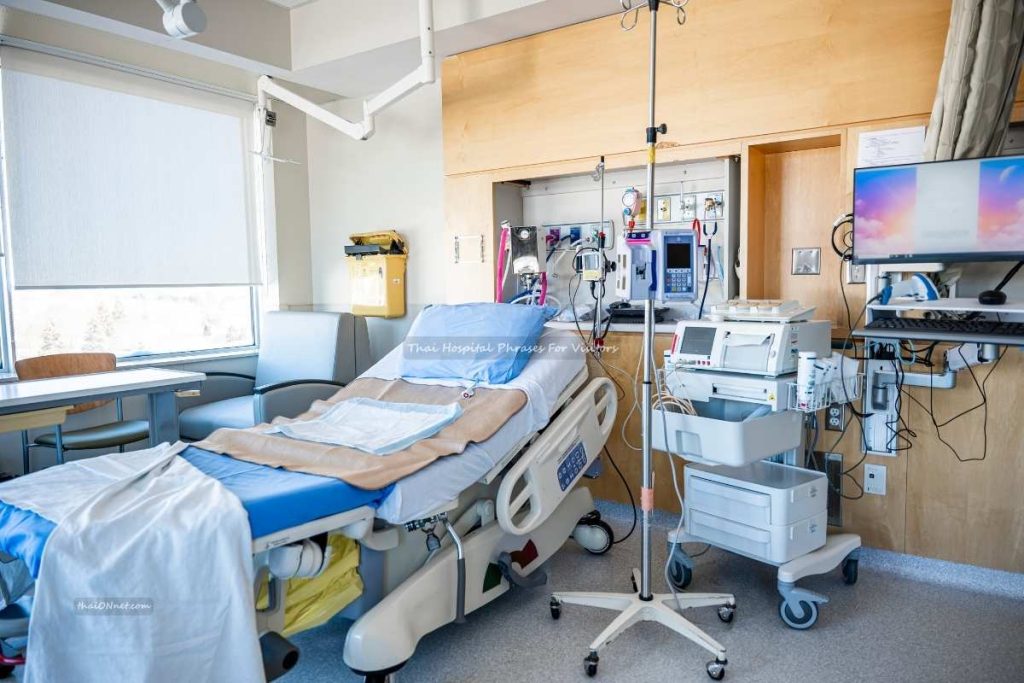
A calm greeting can make the interaction begin more smoothly.
Thank You
Thai phrase:
- Khop khun kráp
- Khop khun kâ
Meaning:
- Thank you
Use this when staff help you, explain something, show you where to go, bring medicine, or assist with paperwork.
This is one of the most useful Thai Hospital Phrases For Visitors because it works in every situation.
Excuse Me Or Sorry
Thai phrase:
- Khor thot kráp
- Khor thot kâ
Meaning:
- Excuse me
- Sorry
Use this when getting someone’s attention, interrupting politely, asking a question, or moving through a busy hospital area.
Please Help
Thai phrase:
- Chuay noi kráp
- Chuay noi kâ
Meaning:
- Please help
This is one of the most important Thai Hospital Phrases For Visitors.
Use it when you need help quickly. You can also show your phone, passport, insurance card, or written symptoms at the same time.
I Do Not Understand
Thai phrase:
- Mai khao jai kráp
- Mai khao jai kâ
Meaning:
- I do not understand
Use this if staff explain something and you are not sure what they mean.
You can then ask for English support or an interpreter.
Do You Speak English?
Thai phrase:
- Pood ang-grit dai mai kráp?
- Pood ang-grit dai mai kâ?
Meaning:
- Can you speak English?
This phrase is very useful at hospitals, clinics, pharmacies, and registration desks.
If the person does not speak English, ask for someone who can help.
Can I Have An Interpreter?
Thai phrase:
- Mee lam phaa saa mai kráp?
- Mee lam phaa saa mai kâ?
Meaning:
- Is there an interpreter?
You can also say in English slowly:
- Interpreter, please.
Many larger hospitals may have language support, but availability can vary.
For important medical decisions, ask for clear explanation in a language you understand.
I Need A Doctor
Thai phrase:
- Tong gaan phop mor kráp
- Tong gaan phop mor kâ
Meaning:
- I need to see a doctor.
“Mor” means doctor.
This is useful at reception, clinics, hotel desks, or pharmacies if you need medical care.
I Need A Nurse
Thai phrase:
- Tong gaan phop phayaban kráp
- Tong gaan phop phayaban kâ
Meaning:
- I need to see a nurse.
“Phayaban” means nurse.
Use this if you need nursing help, dressing changes, basic care, or assistance in a hospital ward.
Where Is The Hospital?
Thai phrase:
- Rong phayaban yoo tee nai kráp?
- Rong phayaban yoo tee nai kâ?
Meaning:
- Where is the hospital?
“Rong phayaban” means hospital.
This phrase is useful if you need directions, but in urgent situations it is better to ask someone nearby to call help or take you directly.
Where Is The Pharmacy?
Thai phrase:
- Raan yaa yoo tee nai kráp?
- Raan yaa yoo tee nai kâ?
Meaning:
- Where is the pharmacy?
“Raan yaa” means pharmacy.
Use this for non-urgent medicine needs or after receiving a prescription.
For serious symptoms, see a doctor rather than only going to a pharmacy.
Where Is Reception?
Thai phrase:
- Pracha samphan yoo tee nai kráp?
- Pracha samphan yoo tee nai kâ?
Meaning:
- Where is reception?
At a hospital, reception or information staff can help direct you to registration, emergency care, outpatient services, or the right department.
I Am Sick
Thai phrase:
- Mai sabai kráp
- Mai sabai kâ
Meaning:
- I am sick
- I do not feel well
This is a simple phrase for general illness.
It does not explain the exact problem, so use it with symptoms, gestures, or written notes.
I Have Pain
Thai phrase:
- Jeb kráp
- Jeb kâ
Meaning:
- It hurts
- I have pain
You can point to the painful area while saying this.
For example, point to your stomach, head, chest, back, tooth, ear, or leg.
It Hurts Here
Thai phrase:
- Jeb trong nee kráp
- Jeb trong nee kâ
Meaning:
- It hurts here
This is one of the most practical Thai Hospital Phrases For Visitors.
Use it while pointing to the painful area.
Headache
Thai phrase:
- Puuat hua kráp
- Puuat hua kâ
Meaning:
- I have a headache.
“Puuat” means ache or pain. “Hua” means head.
Stomach Pain
Thai phrase:
- Puuat thong kráp
- Puuat thong kâ
Meaning:
- I have stomach pain.
“Thong” means stomach or abdomen.
If pain is severe or sudden, seek medical care quickly.
Fever
Thai phrase:
- Mee khai kráp
- Mee khai kâ
Meaning:
- I have a fever.
“Khai” means fever.
Use this if you have a high temperature, chills, or feel feverish.
Cough
Thai phrase:
- Ai kráp
- Ai kâ
Meaning:
- I have a cough.
This is useful at hospitals, clinics, and pharmacies.
Sore Throat
Thai phrase:
- Jeb khor kráp
- Jeb khor kâ
Meaning:
- I have a sore throat.
“Khor” means throat.
Runny Nose
Thai phrase:
- Nam mook lai kráp
- Nam mook lai kâ
Meaning:
- I have a runny nose.
This may be useful for cold-like symptoms.
Vomiting
Thai phrase:
- A-jian kráp
- A-jian kâ
Meaning:
- I am vomiting.
If vomiting is severe, repeated, or linked with dehydration, fever, severe pain, or other serious symptoms, get medical help.
Diarrhea
Thai phrase:
- Thong sia kráp
- Thong sia kâ
Meaning:
- I have diarrhea.
This is a useful phrase for travellers because stomach problems can happen while travelling.
Drink safe fluids and seek medical help if symptoms are severe, prolonged, or concerning.
Dizzy
Thai phrase:
- Wian hua kráp
- Wian hua kâ
Meaning:
- I feel dizzy.
Sit down if you feel dizzy and ask for help.
I Feel Weak
Thai phrase:
- Mai mee raeng kráp
- Mai mee raeng kâ
Meaning:
- I feel weak.
This can be used with other symptoms.
I Cannot Breathe Well
Thai phrase:
- Hai jai mai ok kráp
- Hai jai mai ok kâ
Meaning:
- I cannot breathe well.
This can be serious. Ask for urgent medical help immediately if breathing is difficult.
Chest Pain
Thai phrase:
- Jeb naa ok kráp
- Jeb naa ok kâ
Meaning:
- I have chest pain.
Chest pain can be serious. Seek urgent medical attention.
I Have An Allergy
Thai phrase:
- Phom phae [thing] kráp
- Chan phae [thing] kâ
Meaning:
- I am allergic to [thing].
Men can use “phom.” Women can use “chan.”
Examples:
- Phom phae yaa kráp: I am allergic to medicine.
- Chan phae tua kâ: I am allergic to peanuts.
- Phom phae goong kráp: I am allergic to shrimp.
If you have a serious allergy, carry a written allergy card in Thai and English.
Medicine Allergy
Thai phrase:
- Phae yaa kráp
- Phae yaa kâ
Meaning:
- I am allergic to medicine.
If you know the exact medicine name, show it in writing.
Never guess with medication allergies. Show your records if available.
Food Allergy
Thai phrase:
- Phae ahaan kráp
- Phae ahaan kâ
Meaning:
- I have a food allergy.
Tell staff the exact food if possible.
For serious food allergies, written Thai notes are safer than memory.
I Take Medicine
Thai phrase:
- Gin yaa yoo kráp
- Gin yaa yoo kâ
Meaning:
- I take medicine.
Show the medicine package, prescription, or a list of medications.
This can help doctors and pharmacists understand what you are already taking.
I Have Travel Insurance
Thai phrase:
- Mee insurance dern thaang kráp
- Mee insurance dern thaang kâ
Meaning:
- I have travel insurance.
You can also show your insurance card, policy number, app, or emergency contact details.
Ask the hospital how they handle direct billing, deposits, or reimbursement.
I Have My Passport
Thai phrase:
- Mee passport kráp
- Mee passport kâ
Meaning:
- I have my passport.
Hospitals may ask for identification, especially for registration or insurance paperwork.
Keep a copy of your passport saved on your phone and in your travel documents.
I Need To Register
Thai phrase:
- Tong gaan long thabian kráp
- Tong gaan long thabian kâ
Meaning:
- I need to register.
“Long thabian” means register.
Use this at the registration desk if you are unsure where to start.
Where Do I Pay?
Thai phrase:
- Jaai ngoen tee nai kráp?
- Jaai ngoen tee nai kâ?
Meaning:
- Where do I pay?
“Jaai ngoen” means pay money.
Hospitals may have separate payment counters, pharmacy counters, and insurance counters.
How Much Does It Cost?
Thai phrase:
- Kha chai jaai tao rai kráp?
- Kha chai jaai tao rai kâ?
Meaning:
- How much does it cost?
This phrase is useful for asking about consultation fees, tests, medicine, or hospital charges.
For important costs, ask for written details when possible.
Can I Pay By Card?
Thai phrase:
- Chai bat dai mai kráp?
- Chai bat dai mai kâ?
Meaning:
- Can I use a card?
Hospitals in larger cities may accept cards, but smaller clinics or pharmacies may vary.
Keep more than one payment option if possible.
I Need A Receipt
Thai phrase:
- Khor bai set kráp
- Khor bai set kâ
Meaning:
- Can I have a receipt?
Receipts may be important for travel insurance claims.
Ask for itemised documents if your insurer requires them.
I Need A Medical Certificate
Thai phrase:
- Khor bai rap rong phaet kráp
- Khor bai rap rong phaet kâ
Meaning:
- Can I have a medical certificate?
This may be needed for insurance, airline changes, school, work, or travel documentation.
Ask the hospital what information can be included.
I Need A Prescription
Thai phrase:
- Khor bai sang yaa kráp
- Khor bai sang yaa kâ
Meaning:
- Can I have a prescription?
“Bai sang yaa” means prescription.
Use this if you need medicine details in writing.
Where Is The Pharmacy Counter?
Thai phrase:
- Chong raan yaa yoo tee nai kráp?
- Chong raan yaa yoo tee nai kâ?
Meaning:
- Where is the pharmacy counter?
Hospitals often have a pharmacy area where medicine is collected after payment or consultation.
I Am Pregnant
Thai phrase:
- Tang khan kráp
- Tang khan kâ
Meaning:
- I am pregnant.
Women can say “tang khan kâ.”
For pregnancy-related symptoms, seek professional medical care and explain clearly.
My Child Is Sick
Thai phrase:
- Dek mai sabai kráp
- Dek mai sabai kâ
Meaning:
- The child is not well.
This phrase is useful for families visiting Thailand.
You can also say:
- Tong gaan phop mor dek kráp
- Tong gaan phop mor dek kâ
Meaning:
- I need to see a children’s doctor.
My Child Has A Fever
Thai phrase:
- Dek mee khai kráp
- Dek mee khai kâ
Meaning:
- The child has a fever.
For babies, young children, or high fever, ask medical staff for proper care.
My Child Has Pain Here
Thai phrase:
- Dek jeb trong nee kráp
- Dek jeb trong nee kâ
Meaning:
- The child hurts here.
Point to the area where the child feels pain.
Useful Body Part Words
Useful body part words include:
- Head: hua
- Eye: dtaa
- Ear: hoo
- Nose: jamook
- Throat: khor
- Chest: naa ok
- Stomach: thong
- Back: lang
- Arm: khaen
- Hand: mue
- Leg: khaa
- Foot: thao
- Tooth: fan
- Skin: phiw
These words can help when explaining symptoms.
Pain Level
You can explain pain level simply.
Useful words:
- A little: nit noi
- A lot: mak
- Very painful: jeb mak
- No pain: mai jeb
- Better: dee khuen
- Worse: yae long
Examples:
- Jeb nit noi kráp / kâ: It hurts a little.
- Jeb mak kráp / kâ: It hurts a lot.
- Dee khuen kráp / kâ: It is better.
- Yae long kráp / kâ: It is worse.
Asking Staff To Repeat
Thai phrase:
- Chuay phoot eek krang dai mai kráp?
- Chuay phoot eek krang dai mai kâ?
Meaning:
- Can you say it again?
This is useful if you did not understand the instruction.
You can also ask them to write it down.
Please Write It Down
Thai phrase:
- Chuay khian hai noi kráp
- Chuay khian hai noi kâ
Meaning:
- Please write it down.
This phrase is useful for medicine instructions, addresses, costs, or appointment details.
I Need To Call Someone
Thai phrase:
- Tong gaan tho haa khon kráp
- Tong gaan tho haa khon kâ
Meaning:
- I need to call someone.
Use this if you need to call family, hotel staff, insurance, embassy support, or a friend.
Can You Call My Hotel?
Thai phrase:
- Chuay tho haa rong raem hai noi kráp
- Chuay tho haa rong raem hai noi kâ
Meaning:
- Can you call my hotel for me?
This can help if communication is difficult and your hotel staff can assist.
Can You Call My Insurance?
Thai phrase:
- Chuay tho haa insurance hai noi kráp
- Chuay tho haa insurance hai noi kâ
Meaning:
- Can you call my insurance for me?
You should also keep your insurance contact number saved and printed.
Documents To Bring To A Hospital
Visitors should bring or prepare:
- Passport
- Travel insurance details
- Credit card or cash
- Medication list
- Allergy list
- Existing diagnosis notes
- Emergency contact
- Hotel address
- Phone charger
- Translation app
- Medical documents if available
- Parent or guardian details for children
These documents can make registration and treatment easier.
Tips For Families
Families should prepare extra information for children.
Helpful items include:
- Child’s passport copy
- Travel insurance details
- Allergy information
- Medication list
- Recent symptoms
- Fever notes if any
- Child’s age and weight
- Parent contact details
- Snacks and water if allowed
- Comfort item for the child
- Translation app
Thai Hospital Phrases For Visitors are useful, but written details are especially helpful when caring for children.
Tips For Solo Travellers
Solo travellers should prepare before needing medical help.
Useful steps include:
- Save hotel address in Thai
- Save insurance contact details
- Keep emergency contacts accessible
- Carry passport copy
- Save medication and allergy notes
- Keep phone charged
- Tell someone where you are going if possible
- Ask for an interpreter when needed
- Request written instructions
Hospital visits can feel easier when important information is ready.
Common Mistakes To Avoid
Relying Only On Spoken Thai
Medical details are important. Use written notes, translation apps, and interpreter support when possible.
Not Mentioning Allergies
Always mention medicine and food allergies clearly.
Forgetting Insurance Documents
Hospitals may need insurance information for billing or claims.
Not Asking About Costs
Ask about costs, payment, and documents before non-urgent treatment when possible.
Not Asking For Written Instructions
Medicine instructions can be confusing. Ask staff to write them down.
Waiting Too Long For Serious Symptoms
For serious symptoms, get urgent medical help.
Using Unclear Translation Apps Without Checking
Translation apps can help, but important medical information should be confirmed with hospital staff.
Quick Thai Hospital Phrase List
Here is a quick list of Thai Hospital Phrases For Visitors.
- Hello: Sawatdee kráp / kâ
- Thank you: Khop khun kráp / kâ
- Please help: Chuay noi kráp / kâ
- I do not understand: Mai khao jai kráp / kâ
- Can you speak English?: Pood ang-grit dai mai kráp / kâ?
- I need a doctor: Tong gaan phop mor kráp / kâ
- I am sick: Mai sabai kráp / kâ
- It hurts here: Jeb trong nee kráp / kâ
- I have a fever: Mee khai kráp / kâ
- I am allergic to medicine: Phae yaa kráp / kâ
- I take medicine: Gin yaa yoo kráp / kâ
- Where is the hospital?: Rong phayaban yoo tee nai kráp / kâ?
- Where is the pharmacy?: Raan yaa yoo tee nai kráp / kâ?
- Where do I pay?: Jaai ngoen tee nai kráp / kâ?
- Can I have a receipt?: Khor bai set kráp / kâ
- Please write it down: Chuay khian hai noi kráp / kâ
Save this list on your phone before travelling.
👉 “For more everyday language practice, visitors may also find these Thai Shopping Phrases For Markets And Malls.”
Conclusion
Thai Hospital Phrases For Visitors can make medical situations in Thailand less stressful. Visitors do not need to speak fluent Thai, but simple phrases can help with registration, symptoms, pain, allergies, medicine, payment, interpreters, pharmacies, and asking for help.
The most useful phrases include please help, I need a doctor, I do not understand, can you speak English, it hurts here, I have a fever, I am allergic to medicine, and please write it down.
For medical care, clear communication is important. Use Thai phrases together with written notes, a translation app, travel insurance documents, passport details, and interpreter support when needed.
With preparation and a few Thai Hospital Phrases For Visitors, travellers can feel more confident if they need medical help in Thailand.
FAQ
What Are The Most Useful Thai Hospital Phrases For Visitors?
The most useful Thai Hospital Phrases For Visitors include “chuay noi” for please help, “tong gaan phop mor” for I need a doctor, “jeb trong nee” for it hurts here, and “mai khao jai” for I do not understand.
How Do I Say I Need A Doctor In Thai?
Say “Tong gaan phop mor kráp” if you are male and “Tong gaan phop mor kâ” if you are female.
How Do I Say I Am Sick In Thai?
Say “Mai sabai kráp” if you are male and “Mai sabai kâ” if you are female.
How Do I Say It Hurts Here In Thai?
Say “Jeb trong nee kráp” if you are male and “Jeb trong nee kâ” if you are female while pointing to the painful area.
How Do I Ask If Hospital Staff Speak English?
Say “Pood ang-grit dai mai kráp?” if you are male and “Pood ang-grit dai mai kâ?” if you are female.
How Do I Say I Have A Fever In Thai?
Say “Mee khai kráp” if you are male and “Mee khai kâ” if you are female.
How Do I Say I Am Allergic To Medicine In Thai?
Say “Phae yaa kráp” if you are male and “Phae yaa kâ” if you are female. Show written allergy details if possible.
What Documents Should Visitors Bring To A Thai Hospital?
Visitors should bring a passport, travel insurance details, payment method, medication list, allergy information, hotel address, and emergency contact details.
Should I Use A Translation App At A Thai Hospital?
Yes, a translation app can help, but important medical information should be confirmed with hospital staff, an interpreter, or written notes.
Are Thai Hospital Phrases Enough For Medical Care?
No. Thai Hospital Phrases For Visitors can support basic communication, but they should not replace professional medical advice, interpreter support, or emergency care when needed.